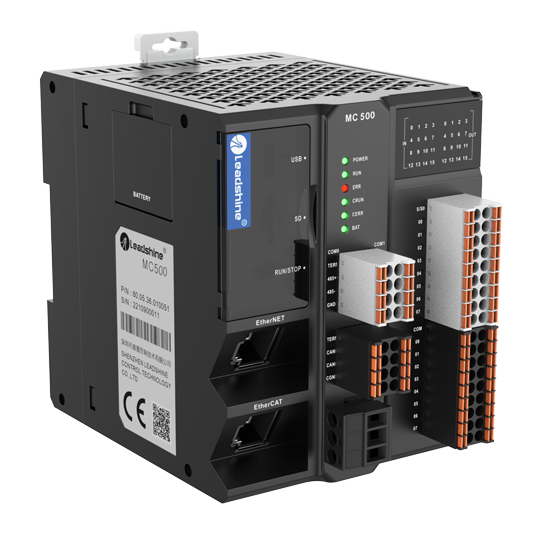
In the intricate dance of modern manufacturing, where precision and timing are paramount, the industrial PLC (Programmable Logic Controller) serves as the tireless conductor. These ruggedized computers have replaced the complex banks of relays and timers that once controlled factory floors, offering a flexible, digital solution for automation. At its core, a PLC is designed to survive harsh environments—dust, moisture, heat, and vibration—while executing control instructions with millisecond-level reliability. For companies like Leadshine, which specializes in motion control and automation solutions, the PLC represents the central “brain” that coordinates the muscle of servo drives and stepper motors to create cohesive, efficient machines.
The Cyclic “Heartbeat” of Automation
The fundamental operation of an industrial PLC is based on a continuous loop known as the scan cycle. Unlike a standard office computer that might pause to wait for user input, a PLC operates in real-time. This cycle consists of three primary steps: Input Scan, Program Execution, and Output Scan. During the Input Scan, the PLC takes a “snapshot” of the status of all connected sensors and switches. It checks if a limit switch is triggered, if a safety door is closed, or if a temperature sensor has reached a critical threshold. This data is stored in the memory, providing a frozen image of the machine’s state for the processor to analyze.
Processing Logic with Precision
Once the inputs are recorded, the PLC moves to the Program Execution phase. This is where the “logic” in Programmable Logic Controller comes into play. The CPU processes the user-written program, line by line, to determine the appropriate response to the current input states. Leadshine PLCs, such as the versatile MC and SC series, support standard programming languages defined by IEC 61131-3, including Ladder Diagram (LD), Structured Text (ST), and Function Block Diagram (FBD). This flexibility allows engineers to write complex algorithms that can calculate motion trajectories, manage timers, and execute PID control loops. The speed of this processing is critical; high-performance PLC control systems can execute thousands of instructions in a fraction of a millisecond.
Commanding the Physical World
The final step in the cycle is the Output Scan. After the logic has determined what should happen, the PLC updates its output terminals to make it happen. This might involve energizing a relay to start a conveyor belt, sending a digital pulse to a stepper driver, or communicating a speed command to a variable frequency drive. In the context of Leadshine products, this is where the PLC sends precise commands to motion components. The ability to switch outputs rapidly and accurately is what allows an industrial PLC to control high-speed packaging machines or synchronized robotic arms without missing a beat.
The Role of Motion Control in Modern PLCs
While traditional PLCs focused on simple on/off control, modern PLC control systems have evolved to include sophisticated motion control capabilities. The Leadshine product page highlights this evolution with their MC series, which integrates motion control directly into the PLC architecture. Instead of just turning a motor on, these advanced PLCs can manage complex multi-axis interpolation, electronic cams (E-CAM), and rotary flying shears. This integration eliminates the need for a separate motion controller, simplifying the system architecture and reducing wiring complexity for machine builders.
Communication: The Nervous System of the Factory
An industrial PLC rarely works in isolation. It needs to communicate with Human Machine Interfaces (HMIs), other PLCs, and a vast array of smart field devices. This is achieved through industrial communication protocols. Leadshine PLCs are engineered with robust connectivity options, including EtherCAT, CANopen, Modbus, and Ethernet/IP. EtherCAT, in particular, is vital for high-performance automation, allowing the PLC to send real-time updates to dozens of servo drives simultaneously. This seamless connectivity ensures that data flows freely from the factory floor up to management systems, enabling the “smart factory” concepts of Industry 4.0.
Scalability and Form Factor
Industrial applications vary wildly in size and complexity, and PLC control systems must scale accordingly. On the Leadshine product page, one can see a clear segmentation of PLC types to meet these diverse needs. The SC series offers a compact, cost-effective solution for smaller machines or standalone stations where space is at a premium. In contrast, the LC and MC series are designed for larger, more complex systems requiring higher I/O counts and greater processing power. This scalability ensures that engineers can select the exact level of performance required without overpaying for unnecessary features.
Reliability in Harsh Environments
The defining characteristic of any industrial PLC is its robustness. Unlike consumer electronics, these devices are built to run 24/7 for years without rebooting. They feature optically isolated inputs and outputs to protect the sensitive internal electronics from high-voltage spikes and electrical noise common in industrial settings. Leadshine prioritizes this durability in their design, ensuring that their PLCs can withstand the electromagnetic interference generated by large motors and drives. This reliability is the bedrock of industrial automation, preventing costly downtime and ensuring safety for operators.
The Unified Control Solution
In summary, the industrial PLC remains the indispensable core of modern automation, bridging the gap between digital logic and physical action. By continuously cycling through inputs, logic, and outputs, it provides the real-time control necessary for everything from simple assembly jigs to complex production lines. Companies like Leadshine are pushing the boundaries of what these devices can do, merging logic handling with advanced motion control and high-speed communication. For any engineer designing the next generation of machinery, understanding the capabilities of these modern PLC control systems is the first step toward building faster, smarter, and more reliable applications.
