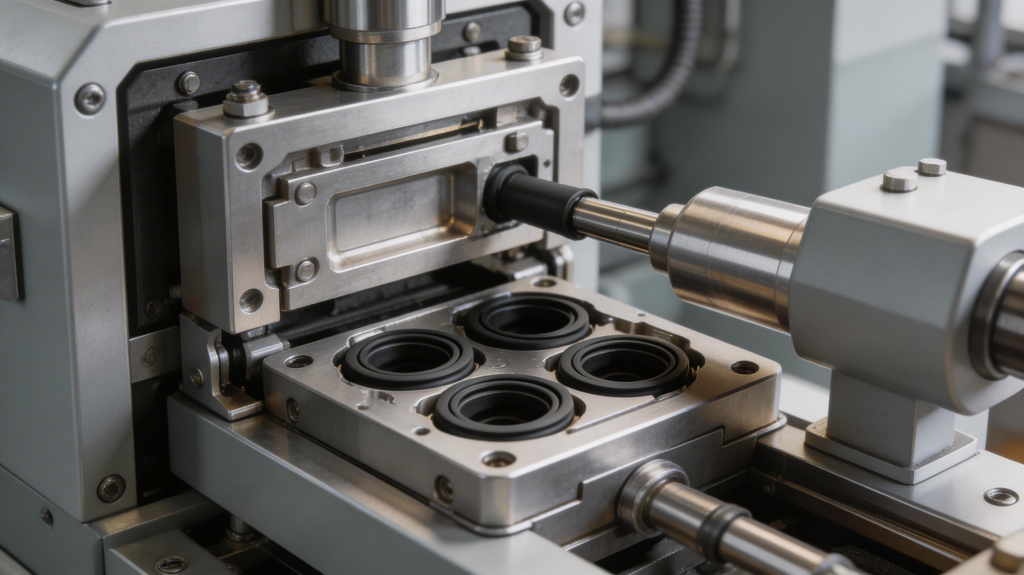
Cold-loading compression methods often create severe production bottlenecks due to the natural thermal insulating properties of elastomers. Rubber injection molding solves this fundamental challenge by utilizing the screw plasticization unit to mechanically pre-condition the material. By converting high-torque rotation into frictional shear heat, the process elevates the compound’s temperature to 90°C–110°C before it even enters the mold, drastically lowering viscosity. This thermal head-start is the primary mechanism that allows manufacturers to reduce in-mold cure times by up to 90%, ensuring rapid delivery for high-volume orders without compromising physical properties.
The Thermodynamics of Screw Plasticization: Utilizing Shear Heat for Efficiency
This section explores how mechanical energy from the screw unit is transformed into critical thermal energy, bridging the temperature gap required for vulcanization and significantly outperforming traditional conduction-based heating methods.
Converting Mechanical Rotation into Thermal Energy
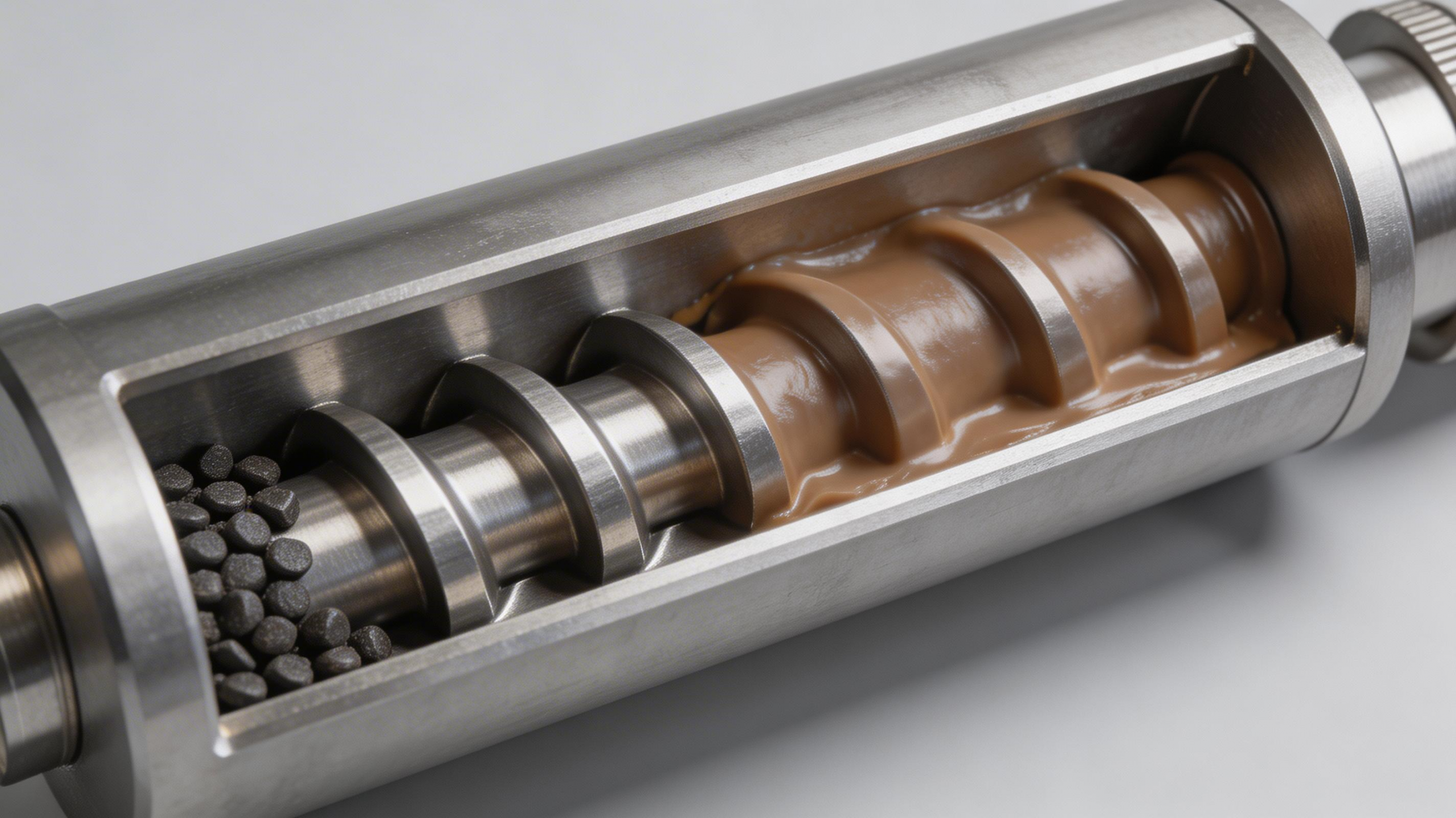
The core advantage of the injection molding rubber process lies in the screw’s ability to generate internal heat. Unlike compression molding, where cold material relies entirely on hot mold walls for conductive heating, the injection unit actively works the material. As the screw rotates, the flight interaction generates intense frictional shear. This mechanical work raises the rubber compound’s stock temperature to between 90°C and 110°C within the barrel.
This “thermal pre-load” is crucial. Rubber is a poor conductor of heat, meaning external heating takes a long time to penetrate to the core of a thick part. By generating heat internally through shear, the plasticization unit ensures the material is uniformly heated and significantly less viscous. This lowers the injection pressure required to fill complex cavities and eliminates the “cold core” phenomenon often seen in thick-walled compression molded parts.
Thermal Efficiency: Injection vs. Cold-Loading Compression
The efficiency gains are mathematically quantifiable. In a cold-loading compression scenario, the material enters the mold at room temperature (approx. 25°C) and must be heated to the cure temperature (160°C–200°C) solely via conduction. This creates a massive thermal lag, often requiring cure times of 5 to 20 minutes depending on thickness.
In contrast, the injection molded rubber process introduces material that is already at ~100°C. The “Delta T” (temperature difference) required to reach the vulcanization threshold is cut in half. Furthermore, the act of injecting the material through a narrow runner system generates additional shear heat, pushing the temperature even closer to the cure point immediately upon filling. This mechanism is directly responsible for reducing cure cycles from minutes to mere seconds—a reduction of up to 90% in optimal setups.
Precision Process Control and High-Volume Applications
Advanced control over shear heat and injection velocity is essential for maximizing throughput while preventing material degradation (scorch). This balance is critical for industries demanding zero-defect rates.
Optimizing Hardware for High-Speed Curing
To harness shear heat without scorching the material, the hardware configuration must be precise. Liquid silicone rubber injection molding machines and standard rubber presses utilize screws with low compression ratios (typically 1.2:1 to 1.4:1). This geometry prevents excessive heat buildup that could trigger premature cross-linking in the barrel.
Process engineers establish safe barrel temperature zones, typically regulated between 60°C and 90°C using water circulation cooling jackets to counteract shear overheating. Dynamic parameter tuning is also employed; back pressure is calibrated to 5–10 bar to ensure uniform density, while screw speeds are limited (30–60 RPM) based on the specific Mooney viscosity of the compound. This precise thermal management ensures that the material remains stable in the barrel but cures almost instantly once injected into the hot mold.
Meeting JIT Standards in Automotive Manufacturing
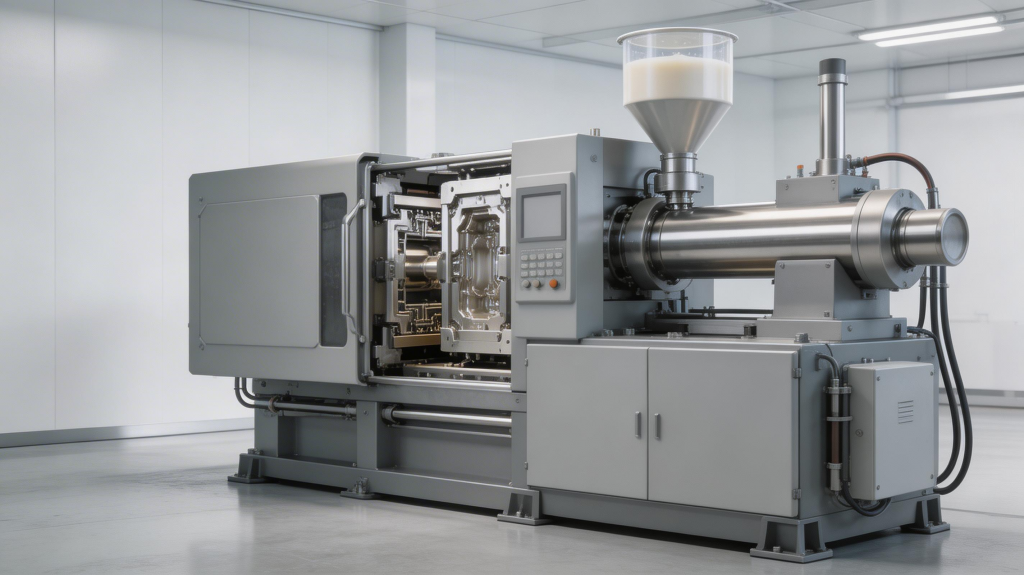
The automotive sector relies heavily on this technology to meet Just-In-Time (JIT) delivery standards. For components like engine compartment seals and gaskets, automotive rubber injection molding offers the consistency required for mass production. Automated dosing eliminates the operator variance inherent in compression molding, ensuring that every shot volume is identical.
This capability is vital for maintaining consistent CPK values (process capability index). High-speed injection cycles allow for the production of millions of parts annually with dimensional stability that compression molding cannot match. By leveraging the cycle speed benefits of shear heat, manufacturers can amortize higher tooling costs over larger production runs, significantly lowering the Total Cost of Ownership (TCO).
Livepoint Tooling Advanced Rubber Injection Molding Capabilities
Livepoint Tooling specializes in delivering high-precision OEM and ODM solutions, leveraging advanced custom rubber injection molding technology to optimize production speed and part quality for global clients.
Precision Engineering and Material Versatility
Our facility is equipped to handle a diverse range of elastomers, including EPDM, NBR, FKM, and Liquid Silicone Rubber (LSR). We utilize advanced screw plasticization techniques to maximize shear heat efficiency, ensuring optimal flow for even the most complex geometries.
High-Volume Production: scalable processes designed to reduce cycle times and meet tight deadlines.
Complex Tooling: expertise in insert molding and overmolding for multi-material components.
Quality Assurance and Validation
We implement rigorous process controls to monitor barrel temperatures and injection pressures, preventing scorch and ensuring consistent cross-linking density.
Dimensional Accuracy: tight tolerance manufacturing suitable for medical and automotive applications.
Comprehensive Testing: in-house rheology and quality checks to validate material performance.
Partner with Livepoint Tooling
Whether you are transitioning from compression molding or launching a new product line, our engineering team is ready to assist. We analyze your part geometry to simulate cure times and demonstrate the cost-saving potential of our injection molding services. Contact Livepoint Tooling today to accelerate your time-to-market with superior molded rubber components.