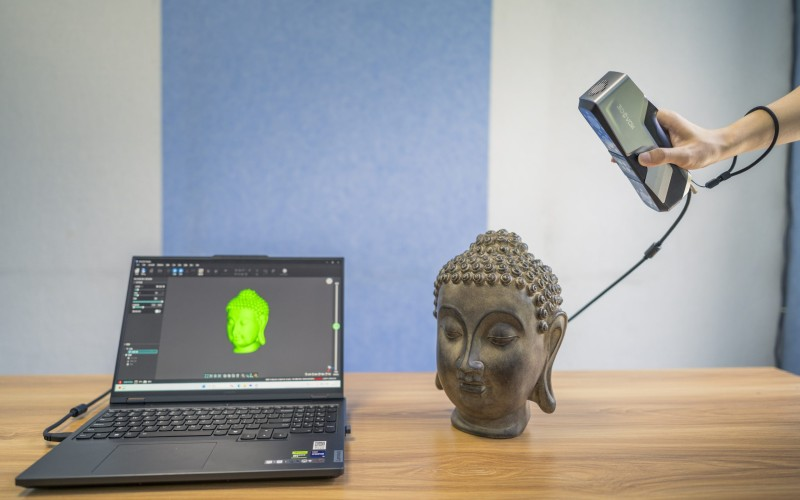
The question, “what are the types of 3D scanners?” necessitates understanding a spectrum of technologies, all of which ultimately rely on robust 3D Scanning Software to function.
The most effective systems today combine high-fidelity, non-contact hardware with sophisticated digital platforms, a synergy perfectly embodied by 3DeVOK’s professional ecosystem. The device’s capabilities are intrinsically linked to the accompanying software for 3D scanning, which dictates the quality and speed of the final output.
The Evolution from Contact Measurement to Full-Surface Scanning
Historically, the most accurate method for dimensional verification was the contact scanner, notably the Coordinate Measuring Machine (CMM). These systems employed a physical probe that contacted the object, recording precise coordinates. While CMMs are foundational in metrology due to their exceptional precision, often reaching micron-level accuracy, they are inherently slow and unable to capture the complete, complex free-form surfaces characteristic of modern industrial designs. This fundamental limitation spurred the shift toward non-contact active scanning.
Modern applications rely primarily on non-contact active systems, which project light or energy to capture surface geometry. The two most prominent types form the backbone of industrial digitization. Structured light scanners, such as the versatile 3DeVOK MQ, project known light patterns onto an object. The system then calculates depth and coordinates by analyzing the distortion of these patterns. This method is incredibly fast, capable of capturing millions of points per second, making it ideal for high-throughput applications, digital archiving, and capturing human body geometry. The second primary type is the laser scanner.
Handheld industrial scanners, like the 3DeVOK MT, often utilize powerful blue laser lines. Laser technology is highly effective on traditionally challenging surfaces, such as reflective or dark metals, and is widely favored in industrial environments for its superior portability and accuracy.
The 3DeVOK MT utilizes a multi-light source system—combining blue lasers, infrared lines, and structured light—to ensure the highest possible point density and accuracy (up to 0.04 ), regardless of the environment or material being scanned. Both structured light and laser systems generate massive point clouds at extremely fast rates, underscoring the necessity of robust software for 3D scanning to efficiently translate this input into a usable, high-fidelity mesh model.
The Defining Role of 3D Scanning Software in the Professional
Workflow The core challenge in modern digitization is not the raw data acquisition itself, but the ability to quickly, accurately, and reliably process, align, and refine the captured point cloud. The quality of the accompanying software for 3D scanning is the definitive factor distinguishing a high-specification machine from a functional, professional tool.
3DeVOK Studio Scanning Software serves as the central command, transforming raw data acquisition into a streamlined, metrology-ready workflow. The 3DeVOK Studio Scanning Software features a powerful Hybrid Alignment engine, which integrates geometric features, textures, and markers to seamlessly align multiple scan passes. This intelligent tracking capability is crucial for accurately capturing complex objects and minimizes the operator’s reliance on manually placed markers. During the capture phase, the system provides Intelligent Data Optimization through a real-time color map that visually guides the operator, ensuring the captured data is of high quality from the very start. This proactive guidance helps eliminate common errors, drastically reducing time spent on post-processing cleanup.
Beyond data integrity, the 3D Scanning Software provides essential functionality for advanced output. Features like Localized High-Resolution Scanning allow the system to fuse fast, large-area infrared data with high-resolution blue laser data of a specific intricate detail into a single, seamless model. If a slight stitching error occurs during a long scanning session, the Frame-by-Frame Undo function allows the operator to instantly retract the erroneous data without losing the entire project, saving crucial production time. Furthermore, the 3DeVOK platform, through its 3DeVOK Studio Scanning software, ensures maximum operational flexibility by supporting Seamless Integration with industry-standard metrology and reverse engineering programs like QUICKSURFACE and Geomagic Design X, providing one-click data transfer for final analysis.
Choosing the Best Integrated Ecosystem
In addition to industrial active scanners, other non-contact types serve specialized purposes. Photogrammetry, a passive technique, uses multiple digital photographs and specialized software for 3D scanning to create meshes, excelling at large-scale, low-accuracy object capture like buildings. Time-of-Flight (Lidar) scanners are highly effective for large environment scanning over massive distances, such as entire factory floors. However, their resolution is typically lower than that of the handheld systems used for product inspection.
Ultimately, the best type of 3D scanner for professional use is the one that forms the most cohesive and efficient system. For professionals demanding maximum versatility, speed, and metrology-grade accuracy across diverse materials and objects, the combination of advanced, multi-sensor active scanning hardware and powerful 3DeVOK Studio Scanning Software provides the superior solution. 3DeVOK delivers this comprehensive ecosystem, ensuring the data capture is stable and high-fidelity, and the subsequent processing is fast, reliable, and perfectly integrated into all downstream engineering applications.
