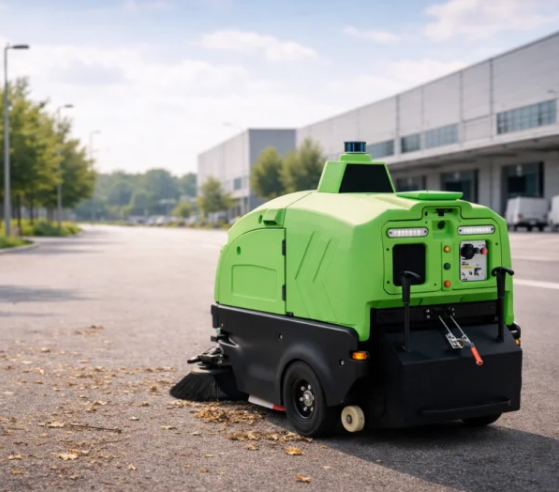
When businesses plan to improve cleaning efficiency, choosing suitable equipment requires more than comparing machine appearance or basic functions. Large facilities need cleaning solutions that match floor types, working areas, maintenance needs, and daily schedules. Greendorph focuses on commercial cleaning solutions and provides equipment designed for different outdoor and industrial environments. Before purchasing a new machine, buyers should evaluate several practical factors to find a solution that fits their operation requirements.
- Check Cleaning Performance and Application Needs of an Industrial Floor Scrubber
The first factor is whether the equipment matches the cleaning environment. Different locations have different requirements, such as warehouses, factories, parking areas, public spaces, and large commercial sites. Buyers should consider floor materials, dust levels, waste types, and cleaning frequency before making a decision.
A suitable industrial floor scrubber should support stable cleaning performance during regular operation. For large areas, factors such as cleaning width, water management, and waste collection capacity can affect daily efficiency. Understanding the working environment helps companies avoid selecting equipment that does not match actual needs.
- Evaluate Automation Functions in an Industrial Cleaning Machine
Automation capability is becoming an important consideration for commercial cleaning projects. A modern industrial cleaning machine can reduce manual workload through intelligent navigation, sensor systems, and remote management features. These functions allow operators to organize cleaning tasks more efficiently.
For example, autonomous cleaning robots can use multiple sensors to identify obstacles and adjust movement paths. Greendorph YJ130 uses laser radar, 3D cameras, ultrasonic sensors, and other technologies to support environmental awareness. This type of system is designed for complex outdoor spaces where continuous cleaning tasks are required.
- Consider Navigation Accuracy and Obstacle Avoidance
Navigation performance directly influences cleaning results, especially in large and open areas. Equipment used in industrial environments needs to recognize surrounding conditions and respond to changes during operation.
When selecting cleaning equipment, buyers should review the navigation method, positioning system, and obstacle detection technology. Greendorph YJ130 supports multi-sensor fusion, which helps the robot detect different types of obstacles. The 3D camera can identify low objects on the ground, while the sensing system supports different distance detection needs.
- Review Maintenance Requirements and Daily Operation
Maintenance requirements are another important factor for long-term use. Businesses should understand how easily the machine can be inspected, cleaned, and managed after purchase. Equipment with practical maintenance design can help reduce downtime during regular operation.
Buyers should also check water tank capacity, waste container size, and battery performance. For example, a larger cleaning area may require equipment with suitable water and waste storage capacity. Greendorph YJ80 provides a 120L water tank and a 100L garbage box, while YJ130 offers a 150L garbage box and a 120L water tank for different cleaning situations.
- Match Equipment Features With Working Scenarios
Different industries have different cleaning conditions, so equipment features should match the application scenario. Outdoor areas may require dust control, edge cleaning, and flexible movement, while indoor spaces may focus more on floor coverage and operation stability.
Some cleaning robots combine multiple functions to handle changing environments. Greendorph YJ80 supports self-following operation through UWB positioning technology. It can work together with operators and provide functions such as high-pressure washing, blowing, and spraying, making it suitable for streets, parks, and public areas.
- Check Remote Management and Operational Control
For companies managing multiple locations, remote operation can improve task organization. A cleaning system with digital management features allows operators to monitor equipment status and arrange cleaning tasks more conveniently.
Remote platforms can provide functions such as task scheduling, machine control, and operation monitoring. This is especially useful for property management companies and service providers that need to manage cleaning equipment across different areas. When purchasing a new system, buyers should consider whether the control method fits their management process.
- Compare Product Reliability, Certifications, and Supplier Support
The final factor is supplier capability and product reliability. Businesses should review product certifications, technical support, and after-sales service before making a purchase decision. These elements influence equipment use throughout its service period.
Certifications such as CE and RCM can provide reference points when evaluating products for different markets. Buyers should also consider whether the supplier understands commercial cleaning requirements and can provide suitable technical assistance. A reliable partnership can help businesses better manage equipment operation and future needs.
Making the Right Choice for Long-Term Cleaning Operations
Choosing cleaning equipment requires a clear understanding of working conditions, automation features, maintenance needs, and management requirements. A suitable industrial floor scrubber should not only complete cleaning tasks but also fit the company’s operational model and site environment.
For businesses exploring smart cleaning solutions, selecting the right industrial cleaning machine involves comparing practical functions rather than focusing only on product appearance. By reviewing these seven factors, buyers can make more informed decisions for industrial and commercial cleaning projects.
