A prototype that works flawlessly on an engineer’s desk rarely stays the same product once it reaches volume production. Requirements shift, customers ask for a cheaper variant or a faster one, and the hardware architecture that seemed perfectly sized for a pilot run suddenly has to stretch across a product line it was never designed to support. What looked like a finished design at the demo stage often turns out to be only the first data point in a much longer product roadmap. The teams that anticipate this shift early tend to avoid the costly redesigns that catch everyone else by surprise.
The Scaling Problem Most Embedded Projects Don’t See Coming
Few teams plan for scale at the prototype stage, because the pressure is simply to get SoMething working. The processor, memory, and interfaces are chosen to solve today’s problem, and the carrier board layout follows whatever configuration makes that first version function correctly.
The trouble surfaces later, when a second market segment wants a lower-cost variant, or a demanding customer wants more processing headroom than the original design allows. Without a scalable foundation, both requests trigger a fresh hardware design rather than a straightforward configuration change.
Why a Standard Form Factor Enables Scalable Growth
This is the problem that well-designed System on Modules were built to solve. By standardizing the physical connector and pinout across a family of modules, manufacturers can swap processing tiers on the same carrier board instead of redesigning hardware for every new performance requirement that emerges after launch.
The benefit compounds over a product’s lifetime. A carrier board validated once against a standard module interface can accept a faster or more power-efficient successor years later, letting a product line evolve gradually rather than forcing a disruptive one-time redesign whenever market demands shift.
Scaling Performance Tiers Without Rearchitecting the Carrier Board
Consider a manufacturer building an industrial HMI product line that needs both an entry-level version for basic status displays and a premium version running live analytics. Designing two separate boards from scratch doubles validation work, doubles the bill of materials to manage, and doubles the risk of a costly design flaw slipping through.
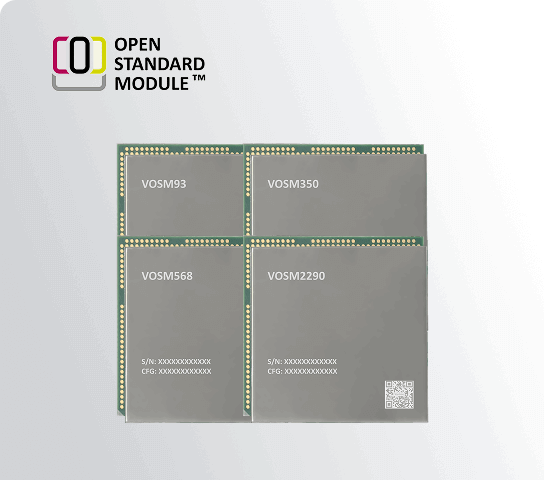
A shared module family avoids this duplication.Vantron offers the VOSM568 and VOSM700 for different performance requirements,but carrier-board reuse depends on their specific OSM size,pinout,power,interface,and software compatibility.
When a Computer on Module Approach Simplifies Multi-Market Products
The same logic extends across processor architectures, not just performance tiers within one family. A computer on module approach, where the compute core remains physically and electrically separated from application-specific I/O, lets manufacturers serve entirely different markets from a shared carrier board design, provided the module family maintains consistent connector standards.
This matters most for manufacturers selling into both cost-sensitive and performance-sensitive segments simultaneously. Rather than maintaining two unrelated hardware platforms, a computer on module strategy allows a single engineering team to support both segments with overlapping documentation, shared driver work, and a common validation process.
Planning for Scale from the First Design Review
Scalability works best when it is planned deliberately rather than discovered after the fact. Choosing a module family with multiple documented performance tiers, consistent software support across variants, and a clear roadmap for future processor generations gives a product line room to grow without forcing engineering teams to start over each time.
This kind of planning also protects against a subtler risk: obsolescence pressure hitting different tiers of a product line at different times. A module family maintained together, rather than sourced piecemeal from unrelated vendors, gives manufacturers a single point of contact for managing transitions across an entire product portfolio.
Vantron’s System on Modules for Scalable Product Architectures
Vantron builds its System-on-Module lineup with this kind of tiered scalability in mind, spanning Open Standard Module, SMARC, Q-Seven, and COM Express form factors across ARM and x86 platforms. This range gives manufacturers a documented path to move between performance tiers as a product line matures, rather than committing to a single fixed configuration at launch.
Within its OSM family alone, Vantron offers the VOSM568 and VOSM700 as complementary options addressing different points on the performance spectrum, while sharing a common physical footprint that simplifies carrier board reuse across variants. This lets a manufacturer introduce a premium tier or a cost-reduced tier later without repeating the carrier board validation work from scratch.
Technical support reinforces this scalability further. Vantron’s engineering teams provide driver packages, reference designs, and FAE assistance across its module families, helping manufacturers move between tiers with confidence rather than treating each new variant as an isolated integration project.
Scalability is rarely about predicting every future requirement in advance. It is about choosing an architecture flexible enough to absorb whatever requirement arrives next, whether that is a cheaper variant, a faster one, or an entirely new market segment. For manufacturers building product lines meant to last, that flexibility is what turns a single successful prototype into a durable, multi-year platform rather than a one-time success that cannot adapt.
