Dental laboratories are under growing pressure to produce customized restorations faster while maintaining consistent quality. Digital dentistry is changing how laboratories manage this challenge by connecting scanning, CAD design, and computer-aided manufacturing into a more streamlined workflow. A 3D dental crown printer can become an important part of this production model, particularly for laboratories handling high volumes of customized restorations.
Moving from Traditional Production to Digital Manufacturing
Dental restoration production has traditionally involved multiple manual processes, physical models, and labor-intensive fabrication. Digital workflows can reduce some of these steps by transferring patient data from scanning systems into dental CAD software and then into manufacturing equipment. This creates a more connected production process and allows laboratories to manage digital files rather than relying entirely on physical models.
For laboratories, the value is not simply that a printer produces a crown. The larger benefit is workflow integration. Once a restoration has been digitally designed, additive manufacturing can turn that design into a physical component without requiring the same material-removal process associated with conventional subtractive production.
Why a 3D Dental Crown Printer Matters for Production Efficiency
Production capacity is a major consideration for commercial dental laboratories. Orders may include numerous individual crowns, frameworks, and other customized restorations, making equipment utilization an important part of operational planning.
A suitable 3D dental crown printer allows multiple dental components to be arranged within one build rather than producing each restoration separately. This can help laboratories make better use of machine time and support more predictable production scheduling. Research comparing additive and subtractive manufacturing has also found that additive manufacturing can be a favorable alternative within digital workflows for fixed dental restorations.
Efficiency, however, should not be judged by printing speed alone. Laboratories should also evaluate build capacity, layer thickness, material compatibility, process stability, post-processing requirements, and the consistency of finished parts.
Precision and Repeatability Are Critical for Dental Labs
Dental restorations require more than attractive designs. Fit and dimensional accuracy are fundamental considerations because marginal and internal adaptation can influence the performance of fixed dental prostheses. Recent research specifically examining selective laser melting notes that the fit of metal restorations is an important factor in their long-term clinical success.
For this reason, laboratories evaluating metal additive manufacturing equipment should look closely at process control rather than relying solely on headline printing speed. Laser characteristics, powder spreading, layer thickness, scanning strategies, thermal management, and support structures can all influence manufacturing results.
Compact Equipment Can Improve Laboratory Space Utilization
Floor space is another practical issue for dental laboratories. Large industrial machines may provide high production capacity, but their physical footprint can make them difficult to install in smaller facilities or dedicated dental production areas.
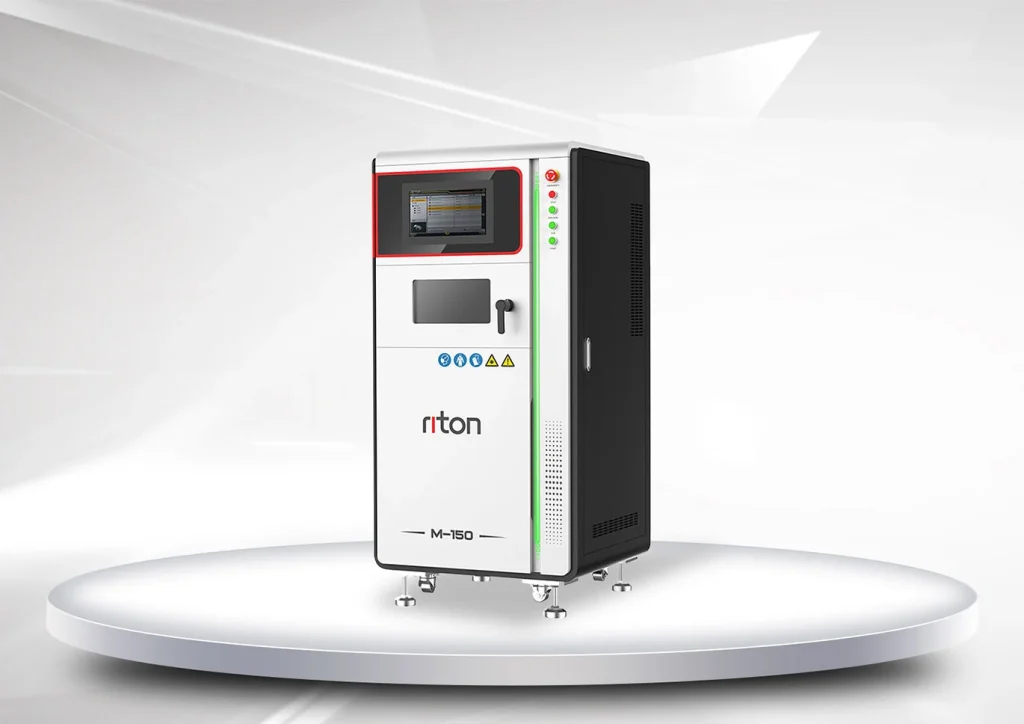
Riton’s M-150 addresses this consideration with a compact design that occupies about 0.8 m². Its listed machine dimensions are 780 × 950 × 1660 mm, while the printer weighs 500 kg. The system has a melting area of Φ150 × 140 mm, including the build plate, providing a balance between equipment size and production capacity.
Such a configuration can be relevant for laboratories that need to expand digital production without allocating excessive floor space to manufacturing equipment.
Riton M-150: Designed Around Dental Metal Production
Riton is a provider of dental 3D printing solutions, and its M-150 is positioned specifically for dental metal restoration production. The system uses a single fiber laser with an output of up to 500 W and a 1.064 μm laser wavelength. Its scanning speed is listed at up to 14,000 mm/s, while layer thickness can be set from 20–60 μm.
The M-150 supports CoCr alloy and titanium alloy and uses nitrogen or argon as protective gas. Per manufacturer‑stated specifications, the printer can produce 200 metal crowns or 17 frameworks in 4.5-hour ideal build conditions. Its powder-spreading system incorporates segmented variable speed, dual-cylinder lifting, and pre-powder spreading to support production efficiency.
What Labs Should Consider When Comparing 3D Metal Printer Companies
When evaluating 3D metal printer companies, dental laboratories should assess the complete production proposition rather than comparing one specification. Build volume, material options, process stability, machine footprint, software compatibility, service capabilities, and production throughput all affect the long-term value of an investment.
Laboratories should also verify whether the equipment is designed around their intended applications. A machine developed specifically for dental metal restorations may offer a more relevant production configuration than a general-purpose metal printer, depending on the laboratory’s workload and manufacturing requirements.
Building a More Scalable Dental Production Workflow
The strongest argument for dental 3D printing is its ability to become part of a broader digital manufacturing system. Modern workflows can connect patient data acquisition, CAD design, and CAM production, allowing laboratories to handle customized restorations through increasingly digital processes.
For growing laboratories, this creates opportunities to standardize production, manage higher order volumes, and reduce dependence on repetitive manual fabrication. The technology does not eliminate the need for skilled technicians, but it can shift their role toward digital design, process management, quality control, finishing, and other higher-value activities.
A Strategic Investment for Modern Dental Laboratories
A 3D dental crown printer is becoming an important production tool for laboratories seeking greater efficiency, repeatability, and digital workflow integration. The right equipment can support high-volume customized production while making better use of available floor space.
Riton‘s M-150 illustrates how a dental-focused metal printer can combine compact dimensions with production-oriented performance. With its 150 mm × 140 mm melting area (including the build plate), 20–60 μm layer thickness, and stated capacity of 200 metal crowns or 17 frameworks in 4.5 hours ideal build conditions, it offers laboratories a practical option for expanding metal additive manufacturing.
For laboratories comparing 3D metal printer companies, the final decision should therefore extend beyond price or printing speed. Equipment precision, capacity, materials, footprint, workflow compatibility, and long-term operational requirements should all be considered. As digital dentistry continues to develop, a well-integrated 3D printing system can provide the manufacturing foundation needed to respond to increasingly customized and demanding dental production requirements.
