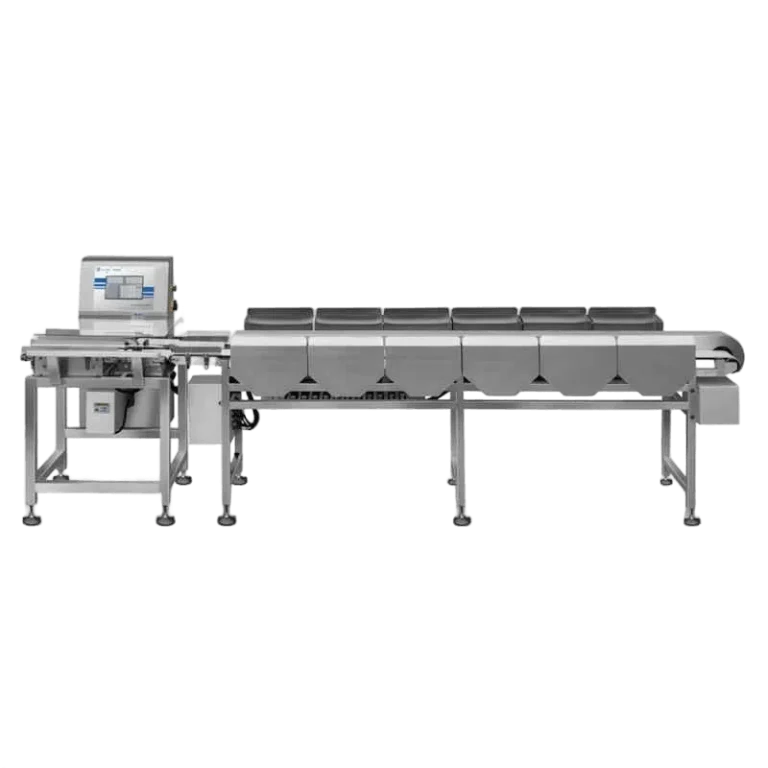
A sorting machine for food processing is an automated system that separates food products according to characteristics such as weight, size, shape, color, or visible defects. Products enter a controlled flow, the system evaluates a relevant characteristic, and an automated mechanism directs each item to the appropriate category. The technology depends on the production objective: weight systems measure items against preset ranges, while optical systems use cameras and image-processing algorithms to assess visual characteristics.
A seafood processor may need weight grading for shrimp or scallops, while a fruit processor may need visual inspection for blemishes or discoloration. Equipment should therefore be specified around the characteristic that determines the required classification.
The Machine Acts as a Decision Point
At its core, a sorting machine performs measurement, classification, and separation. In a weight-grading setup, sensors measure each product as it moves through the system. A control unit compares the value with programmed criteria and assigns the item to a predefined category.
That sequence turns manual grading into a repeatable production step. Instead of relying on an operator to judge every item, equipment applies selected criteria consistently and connects product variation with downstream processing.
Weight Sorting describes systems built around high-precision sensors, automated grading mechanisms, real-time monitoring, and configurable sorting parameters. Its published solutions cover food processing, agriculture, and manufacturing, including seafood, fish, meat and poultry, fruit, vegetables, and prepared foods.
What Determines the Sorting Result?
The answer depends on what variation matters to the processor. Weight is useful when products must be divided into consistent grades or portions. A fish, poultry cut, or seafood item can be assigned to a category after its measured value is compared with preset limits.
Visual characteristics require another measurement method. Optical equipment can evaluate color, size, shape, and visible defects. Vision systems can also identify certain label or coding errors in packaged products. These functions solve different inspection problems, even though both may form part of an automated workflow.
The specification process should begin with the characteristic that determines classification. Consistent weight categories point toward a weight grader; defective or discolored produce points toward optical inspection.
From Measurement to Physical Separation
A typical workflow has four stages: product presentation, measurement, classification, and separation. Conveyors or other handling components maintain a controlled flow so each item can be measured and processed with minimal interruption.
After measurement, the control system compares data with selected criteria. Products can then be directed toward different bins, conveyors, or downstream destinations. Weight Sorting systems can sort products into multiple categories based on weight, while real-time monitoring can provide production information for process management.
The separation mechanism matters as much as the sensor. Product shape, fragility, spacing, and line configuration can affect reliable separation, so the complete material flow must be considered.
Why Weight Grading Fits Variable Food Products
Food products rarely arrive at exactly the same weight. Natural variation is common in fish, seafood, poultry portions, fruit, and other products. The production challenge is to convert that variation into controlled grades rather than leaving the decision entirely to manual sorting.
Weight Sorting describes high-precision sensors, customizable sorting parameters, and integration with production lines.
Controlled grading can support more uniform downstream packing and reduce repeated manual weighing. It can also give production teams a clearer view of how incoming variation affects finished grades.
Different Foods Call for Different Sorting Methods
No single technology fits every food product. Seafood operations may use weight grading for shrimp and scallops, while fish lines can combine weighing with controlled handling and monitoring. Meat and poultry applications can use weight-based classification for products such as chicken parts and beef cuts.
Fruit and vegetable lines may place greater emphasis on optical characteristics. The reference describes camera-based systems using image algorithms to identify defective, discolored, damaged, overripe, or blemished products.
“Food sorting” is therefore a process category, not a specific equipment type. The measurement technology should follow the characteristic that determines acceptance, grading, or rejection.
Start Equipment Selection With the Sorting Rule
The most useful starting point is the rule that decides where each product should go, not machine capacity alone. A processor should define whether classification is based primarily on weight, visual condition, size, shape, or multiple parameters.
Product characteristics come next. Dimensions, shape, fragility, surface condition, and expected variation influence presentation, measurement, and separation. Line integration is equally important because the sorter must work with upstream feeding and downstream packaging or processing equipment.
Easyweigh approaches automated sorting through configurable equipment for different food-processing scenarios, including weight grading and optical inspection. Its published information emphasizes high-precision sensing, real-time monitoring, customizable features, and production-line integration.
From Product Variation to Controlled Output
A sorting machine for food processing is best understood as a control point that converts natural product variation into defined production categories. It measures a relevant characteristic, applies a predetermined rule, and creates a repeatable separation step.
For buyers, the better question is not which system sounds most advanced. It is which characteristic must be measured, which categories must be produced, and how the equipment should fit the existing line. Once those requirements are clear, weight grading or optical inspection can be evaluated against the actual production task.
Easyweigh provides sorting solutions built around weight and optical technologies for several food-processing environments. Easyweigh’s approach puts the sorting rule, product characteristics, and line workflow at the center of equipment selection, helping buyers evaluate automation according to the production task rather than treating every food application as the same.
