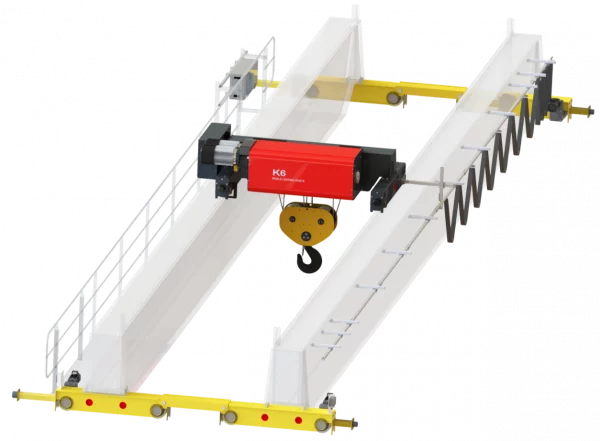
In industrial lifting operations, equipment performance depends on more than the hoist itself. The structural, mechanical, electrical, and safety elements surrounding the lifting mechanism must work together to support controlled movement and consistent load handling. For this reason, choosing a right crane components is an important part of designing, upgrading, and maintaining a lifting system.
From end carriages and gearmotors to crane kits and lifting attachments, each component has a specific function. For an overhead crane, the correct combination can influence travel stability, load positioning, maintenance requirements, and overall service life. Understanding what to evaluate before purchasing replacement or new components can help users avoid compatibility issues and unnecessary downtime.
What Are the Main Crane Components?
A crane is an integrated system made up of multiple assemblies rather than a single machine. The bridge or main girder provides the primary structural support, while end carriages connect the bridge to the runway and enable long-travel movement. Hoists provide vertical lifting, and trolleys allow the hoist to move across the bridge.
Other important overhead crane components include gearmotors, braking systems, electrical equipment, control systems, wheels, limit switches, bumpers, and lifting attachments. Their performance is interconnected. For example, poorly matched travel components can create excessive vibration or uneven wheel loading, while an unsuitable hoist can affect lifting performance and duty-cycle requirements.
For this reason, component selection should consider the crane as a complete system rather than evaluating individual parts in isolation.
Why Component Compatibility Matters
One of the most common concerns when replacing crane parts is whether a new component will integrate correctly with the existing equipment. Dimensions, load capacity, mounting arrangements, travel speed, motor characteristics, electrical configuration, and duty classification can all affect compatibility.
For an existing overhead crane, replacing an end carriage or gearmotor requires more than simply matching physical dimensions. The component must work with the crane’s bridge structure, runway configuration, operating conditions, and required travel performance.
Modular designs can simplify this process when interfaces and specifications are clearly defined. WORLDHOISTS provides crane kits, gearmotors, and end carriages designed for different lifting applications, with component configurations available according to project requirements.
The Role of an Overhead Crane Bumper
Travel safety is another important consideration when selecting crane components. An overhead crane bumper is designed to help absorb energy when a crane or end truck reaches the end of its permitted travel path. Instead of allowing direct structural contact, the bumper provides a controlled stopping interface that can help reduce impact forces.
However, bumpers should not be treated as the primary method of controlling crane travel. Proper braking, limit switches, travel controls, runway alignment, and operator procedures all contribute to safe movement. WORLDHOISTS notes that bumpers are installed at the ends of runway and bridge structures to help absorb kinetic energy when equipment reaches its travel limits.
When specifying a bumper, users should consider the crane’s total moving mass, operating speed, available stopping distance, mounting arrangement, and expected duty cycle. These factors determine whether a particular bumper design is appropriate for the application.
What Should You Check Before Purchasing Components?
A practical purchasing process begins with the operating requirements. Important information includes rated load capacity, span, lifting height, travel distance, operating frequency, ambient conditions, and required speeds.
For replacement parts, existing equipment information is equally important. Users should confirm the original component model, dimensions, mounting points, motor specifications, electrical requirements, and interface details. Photos, drawings, nameplate information, and existing technical documentation can also help suppliers identify suitable replacements.
Environmental conditions should not be overlooked. Equipment operating in steel plants, ports, paper mills, cleanrooms, marine environments, or other specialized facilities may require different component configurations. WORLDHOISTS supplies crane components for applications across industries including oil and gas, metallurgy, nuclear, cleanroom, and marine operations.
How Better Components Support Maintenance
Component quality also affects maintenance planning. Parts that are difficult to inspect, replace, or integrate can increase service time when problems occur. Conversely, modular components can simplify installation and replacement when their interfaces are properly engineered.
End carriages are a good example. They connect the crane structure with the runway and directly influence horizontal travel. Wheel alignment, drive performance, structural strength, and runway conditions all affect how smoothly the crane moves.
A component strategy should therefore consider not only the initial purchase price but also installation time, spare-part availability, inspection requirements, and expected operating life.
Choosing a Crane Components Supplier
The supplier’s technical capabilities can be just as important as the component itself. A suitable supplier should be able to provide clear specifications, engineering documentation, compatibility guidance, and support during installation or replacement.
WORLDHOISTS offers crane kits and lifting attachments, gearmotors, and end carriages, while also providing technical support and solution drawings for project planning. Its product range covers overhead, gantry, and bridge crane applications.
For projects involving non-standard dimensions or operating conditions, technical consultation can help identify potential compatibility problems before manufacturing begins. WORLDHOISTS also provides a crane calculation and configuration platform intended to help users evaluate crane systems and generate corresponding drawings during the planning process.
Building a More Reliable Lifting System
Effective crane design depends on how individual components work together. A dependable system requires appropriate structural parts, controlled travel, reliable lifting mechanisms, suitable safety devices, and properly matched electrical systems.
Whether the goal is to build a new crane, modernize an existing installation, or replace worn components, evaluating the complete operating environment is essential. Selecting crane components based on load requirements, compatibility, travel conditions, safety considerations, and maintenance needs can help create a more consistent and manageable material-handling system.
With its range of crane kits, gearmotors, end carriages, and related equipment, WORLDHOISTS provides components for different lifting configurations. Careful technical selection at the planning stage can reduce installation complications and support dependable crane operation throughout the equipment’s service life.
