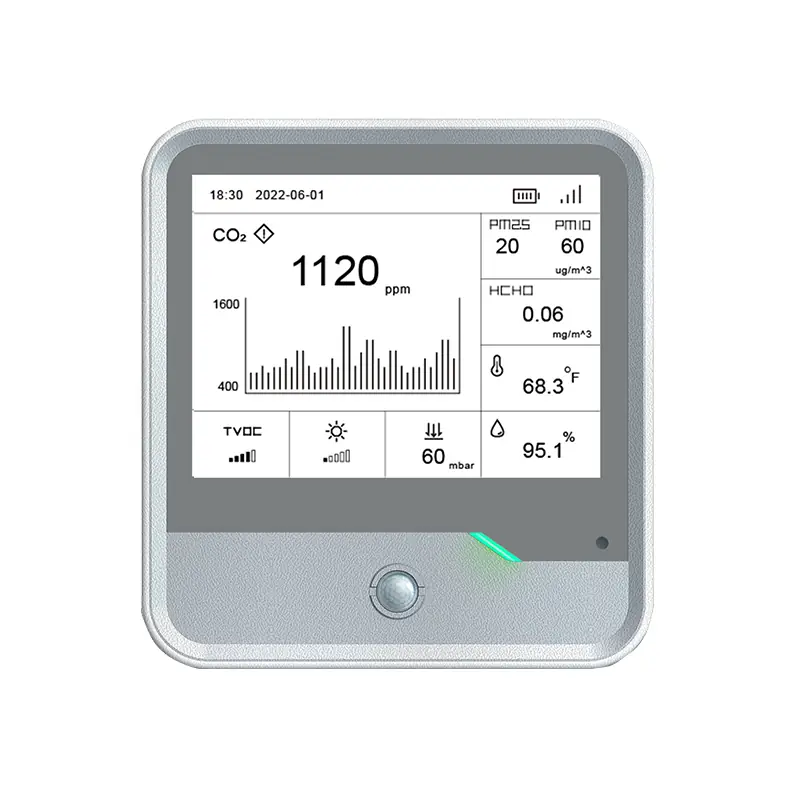
Reliable indoor environmental monitoring has become an essential requirement for commercial buildings, educational facilities, healthcare environments, and other professional spaces. HKT LORA design LoRaWAN sensing products that help users obtain continuous environmental information while simplifying wireless deployment. Their multi-parameter monitoring solution combines sensing technology, LoRaWAN communication, and an E-Ink display to support practical indoor management.
Understanding the Core Design of an air quality sensor
HKT LORA developed their LoRaWAN Indoor Air Quality Sensor as an integrated monitoring device instead of combining multiple independent instruments. A single device can collect various indoor environmental parameters and transmit them through a standard LoRaWAN network.
The product is designed around long-range wireless communication, low-power operation, and centralized management. This architecture reduces deployment complexity while making environmental monitoring easier to expand across different indoor locations.
The compact enclosure also supports installation in offices, retail spaces, classrooms, hospitals, and other buildings where continuous environmental awareness is important.
Multi-Parameter Monitoring Improves Environmental Visibility
Indoor conditions cannot be evaluated through temperature alone. Different environmental factors may influence occupant comfort, equipment operation, and building management decisions.
Their sensor integrates multiple monitoring capabilities, including formaldehyde, ozone, PM2.5 & PM10, temperature, humidity, light, carbon dioxide, atmospheric pressure, and TVOC.
Collecting these parameters from one device allows facility managers to review environmental conditions more efficiently while avoiding separate sensor deployments for each measurement category.
E-Ink Screen Supports Efficient Local Information Display
One distinctive feature of the product is the integrated E-Ink display. Instead of requiring users to access software platforms for every reading, the screen presents environmental information locally. The display remains clearly visible under different lighting conditions while supporting low power consumption characteristics associated with E-Ink technology.
Unlike conventional LCD and OLED displays, which draw constant power to maintain content, the E‑Ink screen consumes power only during data refresh. This greatly reduces overall device power consumption and substantially prolongs battery life. Boasting ultra‑wide viewing angles and anti‑glare properties, it keeps air quality data legible under bright indoor sunlight or dim corridor lighting. There is no longer a need for repeated checks on the cloud platform; on‑site personnel can read all monitored environmental parameters directly from the device, supporting intuitive, efficient on‑site management.
LoRaWAN Wireless Communication Enables Flexible Deployment
Wireless communication plays a major role in modern IoT projects. Their product follows the standard LoRaWAN protocol, making it compatible with standard LoRaWAN gateways as well as third-party network server platforms. This compatibility provides flexibility when integrating the sensor into existing IoT infrastructures.
Instead of depending on proprietary communication methods, organizations can build scalable monitoring systems that accommodate future expansion requirements while maintaining consistent network management.
Visual and Audible Status Indication Simplifies Daily Operation
Environmental monitoring becomes more practical when device status can be understood quickly.
The product combines LED indicators with a buzzer to provide immediate feedback regarding environmental condition changes. These indicators supplement the displayed monitoring information and help operators identify changing conditions without reviewing cloud dashboards first.
Such local notification functions can improve operational efficiency during routine facility inspections.
Installation and Configuration Focus on Practical Deployment
Installation efficiency often influences project implementation costs. They designed the device to support either adhesive mounting or screw installation, allowing users to select the method that best matches their indoor environment.
Configuration can be completed through the supported management methods, while integration with HKT LoRaWAN gateways and cloud platforms helps simplify system deployment without unnecessary configuration procedures.
Low-Power Operation Supports Long-Term Monitoring
Continuous indoor environmental monitoring demands reliable, energy‑efficient power management to sustain 24/7 long‑term operation and reduce frequent maintenance and power consumption costs. The sensor is engineered with a highly optimized low‑power hardware and software solution, perfectly matching the low‑energy characteristics of LoRaWAN long‑distance transmission and E‑Ink display, effectively minimizing standby and operating power consumption. Running on four replaceable AAA alkaline batteries, the sensor enables completely cable‑free wireless deployment for convenient installation across various indoor scenarios.
This battery‑only design allows system designers to select installation locations freely according to on‑site monitoring requirements and project budget, instead of being limited to mains power outlet positions. The optimized low‑power design delivers multi‑year battery life under typical operating conditions, lowers post‑deployment maintenance frequency and operational costs, and ensures stable, uninterrupted long‑term environmental data monitoring for smart building systems.
Compatible Architecture Supports Future IoT Expansion
Many organizations expect monitoring systems to evolve over time. By adopting standard LoRaWAN communication, the device can operate alongside gateways, cloud platforms, and other compatible infrastructure components. This helps organizations extend monitoring coverage without redesigning the entire wireless architecture.
The result is a solution that fits both new IoT projects and existing smart building deployments where interoperability remains an important consideration.
Supporting Smarter Indoor Environment Management
Environmental monitoring delivers greater value when reliable sensing, wireless connectivity and practical operation are integrated within a single solution. Their LoRaWAN Indoor Air Quality Sensor enables comprehensive indoor monitoring with integrated sensing capabilities, an E‑Ink display, native LoRaWAN compatibility and flexible installation options. It accurately detects a full range of indoor environmental indicators, providing stable, low‑power data transmission to support long‑term operation across diverse indoor scenarios.
HKT LORA focuses on developing professional LoRaWAN IoT devices and complete wireless connectivity solutions for commercial and industrial applications. By combining independent sensor development, efficient gateway integration, and stable cloud platform technical support, the enterprise helps global customers build scalable, high-precision indoor monitoring systems. These well-structured systems support enterprises in realizing long-term digital transformation, optimizing daily operation management, and achieving more scientific, efficient and smarter indoor environmental management across offices, shopping malls and industrial workshops.
