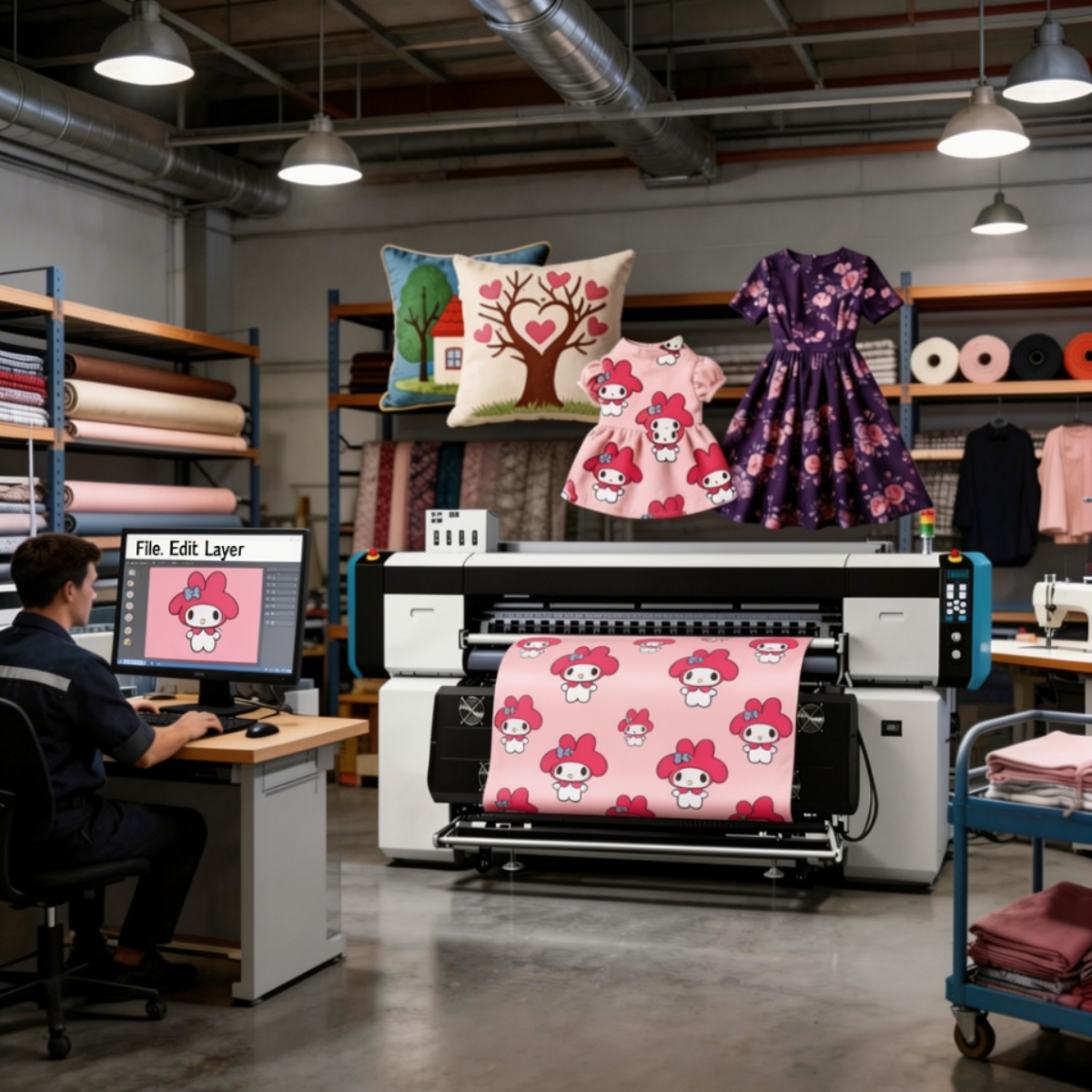
Modern textile manufacturing relies heavily on advanced digital heat transfer equipment to meet high-volume production demands. A Sublimation Printer engineered for large-format applications allows apparel producers and soft signage manufacturers to deposit specialized water-based dye inks onto transfer paper before bonding them heat-activated into synthetic fabrics.
Understanding Wide-Format Dye Transfers
Industrial dye-sublimation systems convert specialized dye inks directly into a gaseous state under heat and pressure, bypassing the liquid phase entirely. This physical process embeds color deep within synthetic polyester fibers rather than depositing a layer on the surface. Consequently, finished graphics maintain natural fabric breathability while resisting wash degradation over extended commercial use.
Commercial printing facilities utilize wide-format equipment to handle continuous roll media up to several meters wide. High-density textile production demands steady ink feed rates and precise drying channels so that high-speed transfers maintain continuous color accuracy across large production runs.
Core Operating Mechanisms of Heat Press Transfer
Dye transfer technology operates through a synchronized two-step production workflow. First, the digital printing unit transfers high-resolution artwork onto coated transfer paper using precise CMYK or expanded gamut ink sets. After initial drying, the printed paper and polyester substrate feed simultaneously through a rotary calender or flatbed heat press.
Thermal activation occurs within temperature ranges between 180°C and 210°C, causing polyester fibers to open and absorb sublimated gas molecules. Once cooled, the polymer structure seals completely, locking colors inside the substrate. This chemical process helps improve that finished textiles retain original texture without stiff surface residues.
Key Technical Components and Precision Engineering
High-volume digital textile machinery relies on heavy-duty steel frameworks and stable linear guides to maintain mechanical stability. Equipment built by Xinflying incorporates precision drive motors and multi-head carriage arrays that deliver consistent droplet alignment across broad printing spans. Robust chassis design prevents vibrational distortions during continuous high-speed passes.
The underlying printhead technology plays a critical role in controlling dot placement and micro-gradient transitions. Utilizing an A1 sublimation printer configuration equipped with industrial piezoelectric heads, production lines achieve sharp line definition and deep color saturation required for high-grade sportswear and decorative textiles.
Industrial Applications Across Textile Sector
The garment manufacturing sector utilizes wide-format sublimation extensively for teamwear, fashion apparel, and activewear. Because sublimated dyes fuse directly into synthetic matrices, activewear garments retain full elasticity, moisture-wicking properties, and breathability without cracking or peeling under mechanical strain.
Beyond apparel, interior decorators and commercial advertising firms apply wide-format transfer systems to produce flags, exhibition banners, and acoustic fabric wall coverings. Large fabric panels offer lightweight transport options and vivid color rendering suitable for indoor and outdoor visual displays.
Architectural Benefits for High-Volume Production
Industrial dye transfer machinery offers continuous output capabilities designed to minimize downtime in busy print facilities. Variable droplet technology optimizes ink consumption while maintaining solid color density across dark backgrounds. Integrated roll-to-roll feeding systems support uninterrupted overnight operation for large-scale orders.
Manufacturers like Xinflying engineer integrated heating and drying systems into their production hardware to stabilize transfer paper before rolling. Proper inline drying prevents ink bleeding and ghosting, maintaining sharp image clarity during high-volume fabric processing.
Printhead Configuration and Maintenance Systems
Industrial digital equipment utilizes advanced printhead configurations such as the Epson i3200 series to execute precise dot placement. Models like the Xinflying XF-O2000-4132 utilize 4 pcs i3200 printheads setups to balance rapid square-meter throughput with fine photographic resolution. Proper ink degasification systems help preserve uniform droplet trajectory during long print runs.
Automated capping stations and moisture-retaining maintenance modules safeguard delicate nozzle plates from ink drying during idle periods. Automated cleaning cycles clear residual dye without requiring manual operator intervention, extending overall printhead service life in demanding industrial environments.
Media Compatibility and Material Requirements
Successful dye sublimation requires substrates composed of at least 70% synthetic polyester content or polymer-coated rigid materials. Natural fibers like pure cotton do not bind with disperse dye molecules, making polyester blends and synthetic textiles the standard media choice for this transfer method.
Selecting appropriate sublimation transfer paper weights impacts ink absorption and transfer yield. Lightweight transfer papers optimize drying speed for rapid roll-to-roll operations, whereas heavier coated papers prevent cockling when processing high-ink-density graphic designs on an A1 sublimation printer.
Operational Workflow Integration and Efficiency
Digital textile workflows reduce setup times compared to traditional screen printing methods. Operators import vector graphics directly into raster image processor (RIP) software to manage color profiles, layout nesting, and ink limit controls. This digital pipeline enables fast turnarounds on custom orders and short-run production batches.
Integrating an A1 sublimation printer into established textile workflows streamlines digital proofing and rapid prototyping. Production managers adjust color values electronically without manufacturing physical printing screens, significantly lowering material waste during sample development.
Conclusion
Industrial digital textile equipment continues to transform soft goods manufacturing by providing rapid turnarounds, exceptional color vibrancy, and durable fabric finishes across wide-format applications. Adopting advanced digital transfer systems allows commercial print providers to fulfill complex custom orders while lowering overall operational costs and material waste.
