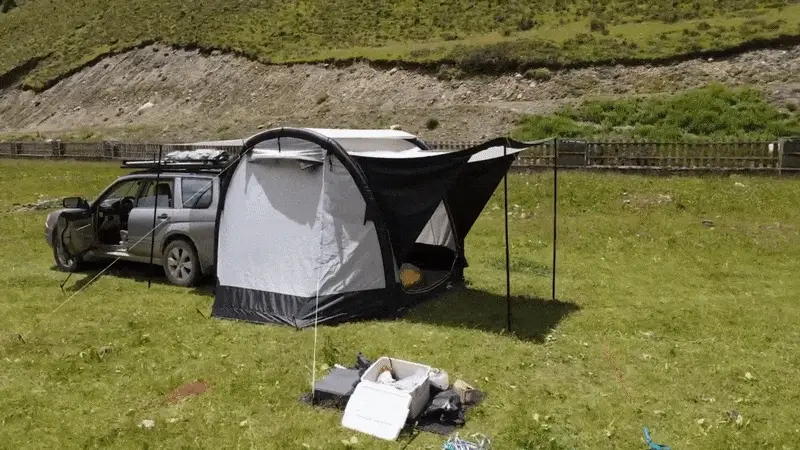
Setup time means something different to a family than it does to a solo backpacker. A single hiker can afford to fumble with poles for twenty minutes without much consequence; a parent unloading a car with two tired kids and daylight running out has far less margin before setup stops being a minor inconvenience and becomes the reason the evening goes sideways. That difference in stakes is part of why setup speed tends to matter more to family campers than almost any other single spec on a tent, often outweighing considerations like color or brand recognition when a trip is planned around young children.
Why Traditional Multi-Pole Tents Slow Families Down
A standard freestanding family tent usually involves threading several poles through fabric sleeves, aligning corners, and staking out multiple points — a process that takes longer with more hands “helping” than fewer. Add wind, an unfamiliar site, or fading light, and a tent that takes fifteen minutes solo can stretch to twenty-five minutes with kids involved, since attention is split between assembly and supervision.
Larger tents compound this further: more interior space generally means more poles, more stake points, and more fabric to manage during both setup and teardown, with each additional pole segment adding another point where something can snag or misalign.
None of this reflects a flaw in any specific tent; it’s simply the nature of pole-and-stake construction, which scales in complexity roughly with a tent’s size — and family tents tend to be some of the largest on the market, which is exactly where the time cost accumulates.
A Different Approach: Vehicle-Connected Setup
A car extended tent attaches to the vehicle, so the car becomes part of the shelter’s layout instead of something to pack around. THECATAL’s Smart Shell works this way: it can be set up as a rear tent for sleeping or as a side tent for cooking and relaxing, and it goes up in about 3 minutes with no complex assembly.
Site conditions, wind, and familiarity with the tent all affect the time, so a practice pitch at home or in a parking lot before the trip is more useful than counting on the quoted figure at dusk.
What Setup Looks Like in Practice
For families, a short setup changes how arrival and departure feel, particularly when children are tired or the schedule revolves around naps and early checkouts. Packing the shelter away deserves the same attention as pitching it, since a tired group is as likely to rush teardown as setup.
The Smart Shell’s vehicle connection avoids the tailpipe, which suits both electric and gasoline vehicles. On a gasoline vehicle, the attachment point and exhaust clearance should still be checked before installation, and the car should be parked with open air around the tailpipe.
Space Considerations for a Family of Four
Families shopping for a 4-person car camping tent usually weigh interior space against ease of setup, because the two do not always move together. Bigger tents are usually slower to pitch. The Smart Shell’s interior measures 3.5 m × 2.5 m (11.5 ft × 8.2 ft), which leaves room to sleep, store gear, or sit comfortably during long trips.
How many people that comfortably covers depends on the sleeping arrangement. Laying out sleeping bags, storage bins, and overnight bags on a floor of that size, using masking tape or a tarp at home, gives a clearer answer than a headcount. The connection-based design offers a way to gain living space without adding the setup steps a freestanding tent of similar size would typically require.
Flexibility When Plans Change Mid-Trip
Family trips seldom go exactly as planned. Someone needs to run into town for supplies, or the group decides to relocate within the campground. The Smart Shell can also be set up on its own at the campsite as a standalone shelter, which lets the tent stay in place while the car leaves, instead of forcing a full teardown. At 26 lb (12 kg), the complete tent is easy to transport, and repositioning it is a manageable task when one parent is watching the kids while the other handles gear.
Weighing the Trade-offs
A connection-based tent is not automatically better than a traditional one. The trade-offs are simply different. The Smart Shell is made from silicone-coated ripstop 70D nylon and is waterproof, windproof, snow-proof, and heat-resistant. It can also connect to the vehicle’s air conditioning system, electric or gasoline, to adjust the temperature inside, which helps when children need to nap on a hot afternoon or sleep through a cold night.
The rear and side configurations depend on a compatible vehicle being parked nearby, which a standalone family tent does not require. For families whose trips are mostly vehicle-based, the reduced setup effort adds up over a season of repeated weekends.
Making the Call for a Specific Family
The right choice depends on how a given family camps most often. A group that stays within reach of a parked vehicle and values a quicker setup over maximum floor space may find the time savings add up. A family that regularly hikes into walk-in sites without a car nearby would get little use from a vehicle-linked design, however quickly it goes up.
Matching setup style to a family’s actual travel pattern, instead of choosing on a setup-time figure alone, is a more reliable way to judge whether a connection-based tent is worth the trade-offs. THECATAL backs the Smart Shell with a two-year warranty, which adds some reassurance for a tent meant to travel with a family season after season.
